

Why this decision is harder than it looks
Email hosting looks like a commodity. Every provider offers mailboxes on your own domain, webmail, mobile access, and some storage quota, and the monthly prices cluster within a few riyals of each other. On that basis most Qatar businesses pick whichever option their web developer already resells.
The decision only reveals itself later, usually in one of three moments: when a regulator or a client contract asks where correspondence is stored, when the domain starts landing in spam folders and nobody can explain why, or when the company wants to leave and discovers what an export actually contains.
This guide covers what to check before those moments rather than after.
The five questions worth asking
1. Where is the mail physically stored?
Ask for the country and, ideally, the datacentre region. A provider that cannot answer this quickly is a provider that has not thought about it.
Storage location is the question most people stop at. It is genuinely the easiest of the five to verify and the least meaningful on its own, which is why it deserves to be first but not last.
2. Which law governs the company holding the mail?
This is the question that catches people out. A foreign-owned provider with servers in Doha can still be compelled to produce data under its home country's law. Local storage and local jurisdiction are two separate properties, and marketing pages routinely blur them.
If your correspondence is subject to client confidentiality, professional privilege, or a government contract clause, the legal entity matters at least as much as the rack location.
3. Can the provider read your messages?
Almost all providers encrypt mail in transit with TLS and encrypt the disks at rest. Neither prevents the operator reading plaintext on a running server, because the operator holds the keys.
Zero-access encryption is the property that does prevent it: the decryption key is derived on your device and the server never holds it. Very few providers offer it, and the ones that do accept a real trade in exchange, which is covered below.
4. How is deliverability handled?
Three DNS records determine whether your mail reaches inboxes:
- SPF lists which servers may send as your domain.
- DKIM cryptographically signs outgoing mail so receivers can verify it was not altered or forged.
- DMARC tells receivers what to do when SPF or DKIM fails, and sends you reports.
A competent provider configures all three, hands you the exact records to publish, and tells you when to move DMARC from monitoring to enforcement. A provider that gives you an MX record and nothing else is leaving your domain open to spoofing and your mail to the spam folder.
5. What does leaving cost?
Ask before signing, not after. Specifically: can you export every mailbox in a standard format, do exports include folder structure and read state, and are there egress or per-export charges?
An honest answer here is one of the better signals of a provider worth using.
The trade nobody mentions
Zero-access encryption is not free of consequence, and any provider presenting it as pure upside is overselling.
If the operator cannot read your mail, the operator also cannot recover it. Lose the password and the recovery phrase and the mailbox is gone permanently. Server-side full-text search over message bodies becomes constrained, because the server holds ciphertext. IMAP clients such as Outlook and Thunderbird need server-side plaintext for search, flags, and metadata, so connecting them is a deliberate reduction in the guarantee rather than a seamless feature.
Those constraints are the mechanism working correctly. Whether they are worth accepting depends entirely on how sensitive your correspondence is, which is a business judgement rather than a technical one.
What migration actually involves
Moving providers is more predictable than most people expect, provided it is sequenced properly.
- Provision first. Create every mailbox on the new provider before touching DNS.
- Copy mail across. An IMAP-to-IMAP sync moves existing mail with folders intact, and can run while the old provider is still live.
- Lower your MX TTL to 300 seconds a day ahead, so the cutover propagates in minutes rather than hours.
- Publish SPF, DKIM, and DMARC for the new provider before the switch, not after.
- Switch MX records. Mail begins arriving at the new provider.
- Run a delta sync to catch anything delivered to the old provider during propagation.
- Keep the old account open for two to four weeks. It costs one more billing cycle and removes all the risk.
The failure mode is doing step 5 first. Mail then arrives at a provider with no mailboxes and bounces, and bounced business mail is rarely resent by the sender.
Local provider or global platform?
Both are defensible, and the honest answer depends on what your organisation actually needs.
A global platform is the better fit when you want deep integration with a document suite your staff already use, when you have a large distributed workforce, or when convenience and familiarity matter more than jurisdictional control. These platforms are operationally excellent and it would be dishonest to pretend otherwise.
A Qatar provider is the better fit when correspondence is confidential as a matter of professional obligation, when a contract or regulator requires national control, or when you want an accountable local party who answers the phone in your timezone.
Most Qatar businesses do not need the second category. The ones that do tend to know it already: law firms, medical practices, financial institutions, and government suppliers.
Email hosting and PDPPL
Qatar's Personal Data Privacy Protection Law (Law No. 13 of 2016) requires organisations processing personal data to apply appropriate protective measures and remain accountable for that data. Mail holds a surprising volume of it: identity documents as attachments, medical details in clinic correspondence, financial records in an accountant's inbox.
Choosing a provider that cannot read message content narrows exposure to the parties who are supposed to see it. That is not compliance by itself, and no provider should claim it is. Compliance is a programme covering retention, access control, breach notification, and staff training. But the storage layer is the piece most often delegated abroad without much thought, and it is the easiest piece to bring back under national control.
Frequently asked questions
QWhat should an email hosting provider in Qatar cost? A: Per-mailbox monthly pricing is the norm for business hosting. Judge the figure against migration cost and deliverability support rather than in isolation, because a cheap provider that lands your mail in spam is the most expensive option available.
QCan I keep my existing domain? A: Yes. Mailboxes are created on your own domain and moving providers means changing MX records. The domain stays yours throughout, which is precisely why it should be registered in your company's name rather than your developer's.
QHow long does migration take? A: The DNS cutover takes minutes with a lowered TTL. The IMAP sync depends on mailbox volume, typically hours for a small team and longer for accounts with years of archive. Neither requires downtime if sequenced as described above.
QDo I need DMARC? A: If you send business mail from your domain, yes. Without it, anyone can spoof your domain and receivers have no instruction on what to do about it. Start in monitoring mode, read the reports, then move to enforcement.
QIs email stored in Qatar automatically compliant with Qatari law? A: No. Storage location is one factor. Legal jurisdiction over the operating company and technical control over who can read the data both matter independently.
QCan I use Outlook or Thunderbird with a Qatar email host? A: With most providers, yes, over IMAP. With zero-access providers, IMAP works but reduces the encryption guarantee, because IMAP requires server-side plaintext for search and flags.
Where FalconMail fits
We built FalconMail as our answer to the second category above: business email hosted and operated in Qatar, on your own domain, with zero-access encryption so that message content is not readable by us, and post-quantum cryptography for correspondence that must stay confidential for decades rather than years.
It is deliberately not the right fit for every organisation, and the trade described earlier is real: no operator-held master key means no operator-led recovery. For law firms, clinics, financial institutions, and government suppliers in Qatar, we think that is the correct trade. For a team that mainly wants convenience and document-suite integration, a mainstream platform is the more practical choice, and we would rather say so.
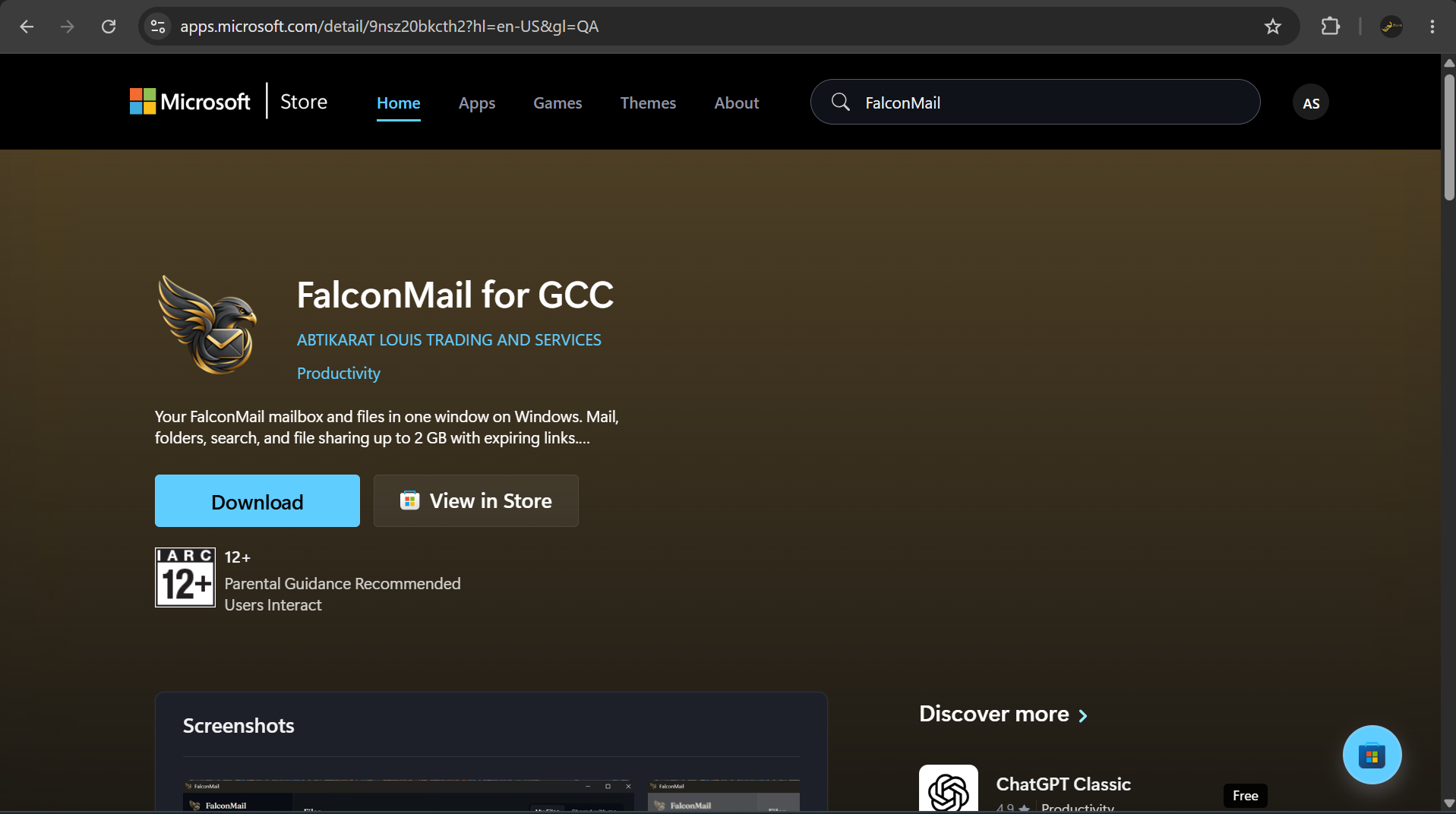
FalconMail runs at email.louis-innovations.com, and the Windows desktop app is published on the Microsoft Store as FalconMail for GCC.
We also handle domain registration and management, so the DNS side of a migration can be done by the same team.
Louis Innovations is Abtikarat Louis Trading and Services (CR No. 173808), based in Doha. If you are evaluating email hosting providers in Qatar and want a straight answer about whether we are the right fit, contact us at info@louis-innovations.com.