
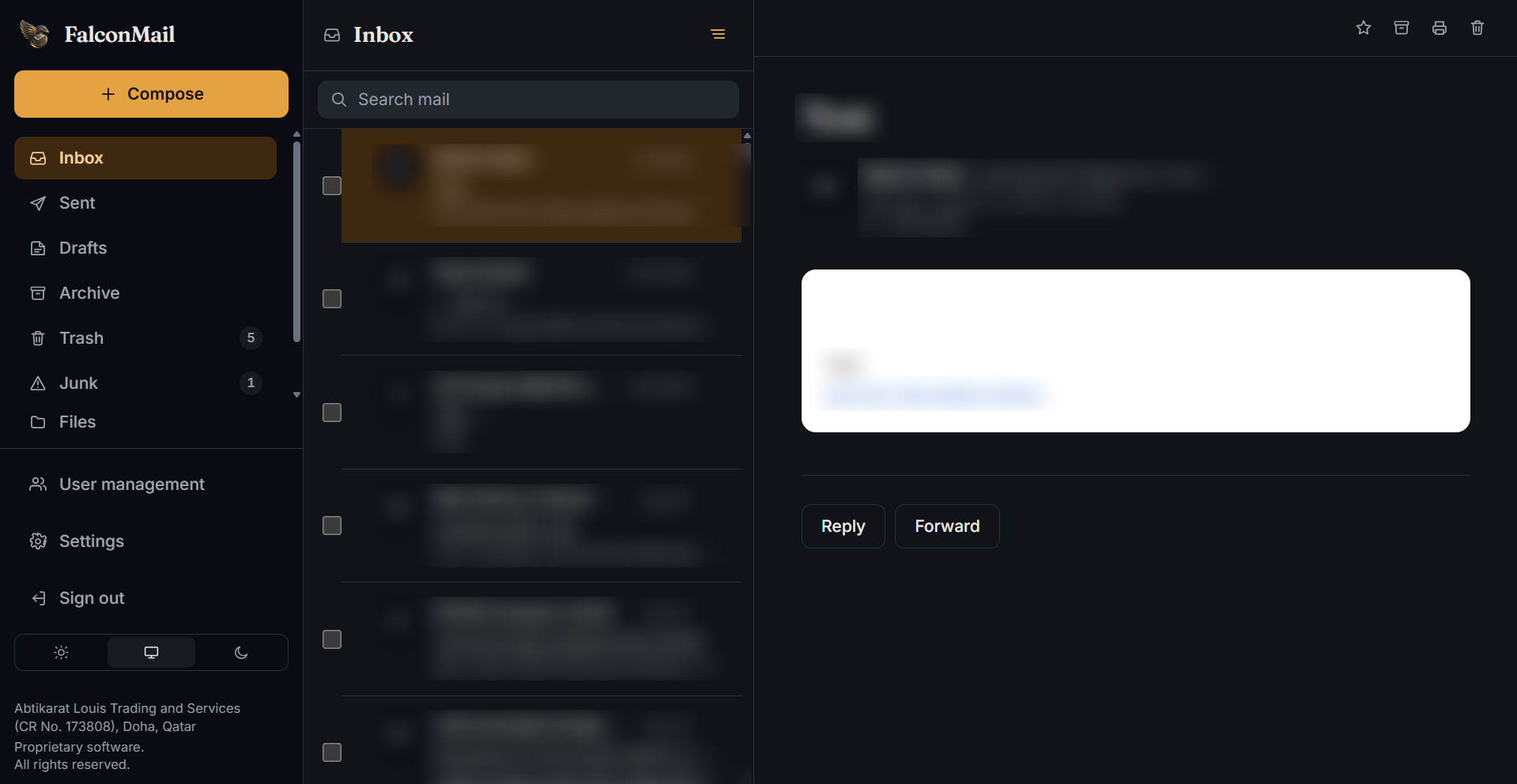
Every organisation in Qatar that uses Gmail, Outlook 365, or a regional reseller of either is making the same trade without usually noticing it. The convenience is real. So is the fact that the plaintext of every message, every subject line, and every attachment sits on servers owned by a foreign company, subject to a foreign legal system, readable by that company's staff and by anyone who compels them.
FalconMail is our answer to that. It is a self-hosted email system we wrote from scratch in Rust, designed so that the operator of the server, including us, cannot read the mail on it.
What data sovereignty actually means for email
The phrase gets used loosely. In practice it has three separate layers, and most "sovereign cloud" offerings only deliver the first one.
Layer one is physical location. The disks are in Qatar. This is the easy part and the part vendors advertise. A regional data centre satisfies it.
Layer two is legal jurisdiction. Whose courts can compel disclosure? A server physically in Doha that is operated by a subsidiary of a US-incorporated parent is still reachable under the US CLOUD Act, which applies to data controlled by US providers regardless of where it is stored. Physical location alone does not settle this question.
Layer three is technical control. Even with the right location and the right jurisdiction, if the hosting provider's administrators can read your mailbox, sovereignty is a policy promise rather than a property of the system. Policies change. Staff change. Breaches happen.
FalconMail is built for the third layer, because the first two are worthless without it. Qatar's Personal Data Privacy Protection Law (Law No. 13 of 2016) and the National Information Assurance policy both push organisations toward controlling personal data rather than delegating it. An email system where the operator is technically incapable of reading user content satisfies that intent in a way that a contractual assurance does not.
Zero-access encryption, not just disk encryption
Most "encrypted" hosting means full-disk encryption. That protects against someone stealing the physical drive. It protects against nothing else, because the disk is unlocked and readable the entire time the server is running, which is always.
FalconMail encrypts at the application layer instead. Each account has a content key generated at signup. That key is wrapped twice: once with a key derived from the user's password, once with a key derived from their recovery phrase. The server stores only the wrapped copies. It never sees the unwrapped key, because unwrapping happens in the user's browser or client.
The consequences are deliberate and worth stating plainly:
- Mail content, subject lines, and attachments are encrypted before they reach the server.
- Search runs entirely on the client. The server never builds a plaintext index, because it has no plaintext to index.
- There is no server-held master key and no administrative recovery path. If a user loses both their password and their recovery phrase, that mailbox is gone. This is a design decision, not a missing feature. A recovery backdoor for the operator is a backdoor for whoever compromises the operator.
- Login uses SRP, so the password itself never travels to the server, not even over TLS.
Full-disk encryption is still applied at setup, but as a secondary layer against physical theft rather than as the primary defence.
Post-quantum cryptography, now rather than later
Encrypted traffic captured today can be stored and decrypted years later once a sufficiently capable quantum computer exists. For ordinary web browsing that matters little. For a decade of a law firm's or a ministry's correspondence, it matters a great deal. Security researchers call this harvest now, decrypt later, and it makes post-quantum protection a present-tense requirement for anything with a long confidentiality lifetime.
FalconMail's transport layer uses hybrid X25519 plus ML-KEM768 key exchange. Hybrid means both a classical and a post-quantum algorithm must be broken to recover the session, so adopting the new algorithm carries no regression if a weakness is later found in it. ML-KEM is the NIST-standardised scheme (FIPS 203) that came out of the post-quantum standardisation process. Application-layer key encapsulation uses the same primitive, with Ed25519 for signatures.
Why Rust, and why from scratch
Email server software has an unhappy security history, and a large share of the serious vulnerabilities in it have been memory-safety bugs: buffer overflows and use-after-free errors in C and C++ parsers chewing through untrusted input from the open internet. An SMTP server is about as exposed as software gets.
Rust removes that entire category at compile time. Writing a mail system from scratch in 2026 is more work than forking an existing one, but forking means inheriting decades of architectural assumptions built when nobody expected the server to be untrusted.
The protocol choices follow from the same reasoning. FalconMail is JMAP-first, because JMAP is a modern, JSON-based mail protocol that works cleanly with client-side encryption. IMAP is offered for compatibility with Thunderbird, Outlook, and Apple Mail, but it is labelled in the interface as a reduced-security mode, because IMAP requires server-side plaintext search, flags, and metadata by design. We would rather tell users exactly which mode they are in than quietly weaken the guarantee and keep the marketing claim intact.
Attachments go through their own pipeline: header and authentication checks, antivirus and YARA rule scanning, then a sandboxed inspection step before anything reaches permanent storage.
The gap we are not hiding
Zero-access encryption protects mail at rest and in transit. It does not protect against an operator with root access reading server memory while a session is live, on ordinary hardware. Closing that gap requires confidential computing hardware, which is not a standard part of a typical self-hosted deployment.
We publish this in our own threat model rather than leaving it for someone else to find. Any vendor claiming an absolute guarantee here, on commodity hardware, is either overselling or has not thought about it carefully.
FalconMail is under active development. The core is built and the webmail client has been verified end to end against a real server, with several hundred tests behind the cryptographic and protocol layers. Outbound relay to external domains and cross-account encrypted delivery are the current work in progress.
How to choose an email service provider in Qatar
If you are comparing email hosting in Qatar, the questions that actually separate providers are narrow. Most vendor comparison pages skip them, so here they are in the order they matter.
Where is the mail stored, and who operates the storage? Ask for the country and the operating legal entity, not just the region name. A Doha data centre operated by a foreign subsidiary is a different risk profile from a Qatari-operated one.
Can the provider's staff read message content? For almost every mainstream provider the honest answer is yes, because server-side spam filtering, search indexing, and web preview all require plaintext. A provider that cannot read your mail has to give up some of those features, and should tell you which.
What happens on a legal request from another country? If the provider or its parent is subject to foreign disclosure law, your data is reachable through that route regardless of where the disks sit.
Is there an operator recovery path? A provider that can reset your password and still give you your old mail necessarily holds a key to it. Convenient, and a single point of compromise.
What does the migration and exit look like? IMAP export, mailbox size limits, and whether you keep your own domain. An email service you cannot leave is a dependency, not a service.
FalconMail answers these as: Qatar, Qatari-operated, no (by construction), no foreign parent, no operator recovery path, and standard IMAP for import and export.
The same reasoning applies outside Qatar wherever data-protection law has teeth. We wrote up the European version of this problem in custom email servers for German enterprises, where GDPR rather than the PDPPL is the driver.
Qatar email hosting and PDPPL compliance
Qatar's Personal Data Privacy Protection Law (Law No. 13 of 2016) requires organisations processing personal data to apply appropriate protective measures and to stay accountable for that data. Mail is where a surprising amount of regulated personal data actually lives: identity documents sent as attachments, medical details in a clinic's correspondence, financial records in an accountant's inbox.
An email system where the provider is technically unable to read content narrows that exposure to the parties who are supposed to see it. It does not by itself make an organisation compliant, and we would not claim otherwise. Compliance is a programme covering retention, access control, breach notification, and staff training. But the storage layer is the part most often delegated abroad without much thought, and it is the easiest part to bring back under national control.
Frequently asked questions
QWhat is the best email service provider in Qatar for confidential business mail? A: For correspondence that must stay confidential and under national control, a self-hosted Qatar email service such as FalconMail is stronger than a foreign cloud mailbox, because the provider cannot read message content at all. For teams that mainly need convenience and deep document-suite integration, a mainstream provider is usually the more practical fit. The right answer depends on how sensitive the correspondence is.
QCan I use my own domain with a Qatar email service? A: Yes. FalconMail runs on your own domain, and mail is delivered to that domain's mailboxes. Moving providers means changing MX records; the domain stays yours throughout.
QIs data stored in Qatar the same as data being sovereign? A: No. Storage location is only the first of three layers. Legal jurisdiction over the operating company and technical control over who can read the data both matter, and a foreign-owned provider with servers in Doha can still be compelled to disclose data under its home country's law.
QDoes encrypted email mean the provider cannot read my messages? A: Not usually. Most providers encrypt in transit (TLS) and encrypt the disks, but hold the keys and can read plaintext on a running server. Zero-access encryption, which is what FalconMail implements, means the decryption key is derived on your device and the server never holds it.
QWhat happens if I lose my password? A: You use your recovery phrase. If you lose both, the mailbox cannot be recovered by anyone, including us. That is the direct consequence of there being no operator-held master key, and it is the trade that makes the rest of the guarantee real.
QCan FalconMail work with Outlook or Thunderbird? A: Yes, over IMAP, which the interface labels as a reduced-security mode because IMAP requires server-side plaintext for search, flags, and metadata. The full zero-access guarantee applies to the FalconMail webmail and JMAP clients.
QIs FalconMail available now? A: It is under active development. The core system and webmail are built and tested; outbound relay to external domains and cross-account encrypted delivery are in progress. Contact us if you want to be an early deployment.
Who this is for
FalconMail suits organisations where the confidentiality of correspondence is part of the business rather than an IT preference: law firms, medical practices, financial institutions, government entities, and any company whose contracts or regulator require that data stay under national control in a way that survives an audit question harder than "where is the server?"
It is self-hosted and proprietary, developed by Abtikarat Louis Trading and Services (CR No. 173808) in Doha, alongside our other software products and cybersecurity work. If your organisation needs email that stays in Qatar in every sense of the word, contact us at info@louis-innovations.com. FalconMail runs at email.louis-innovations.com.